
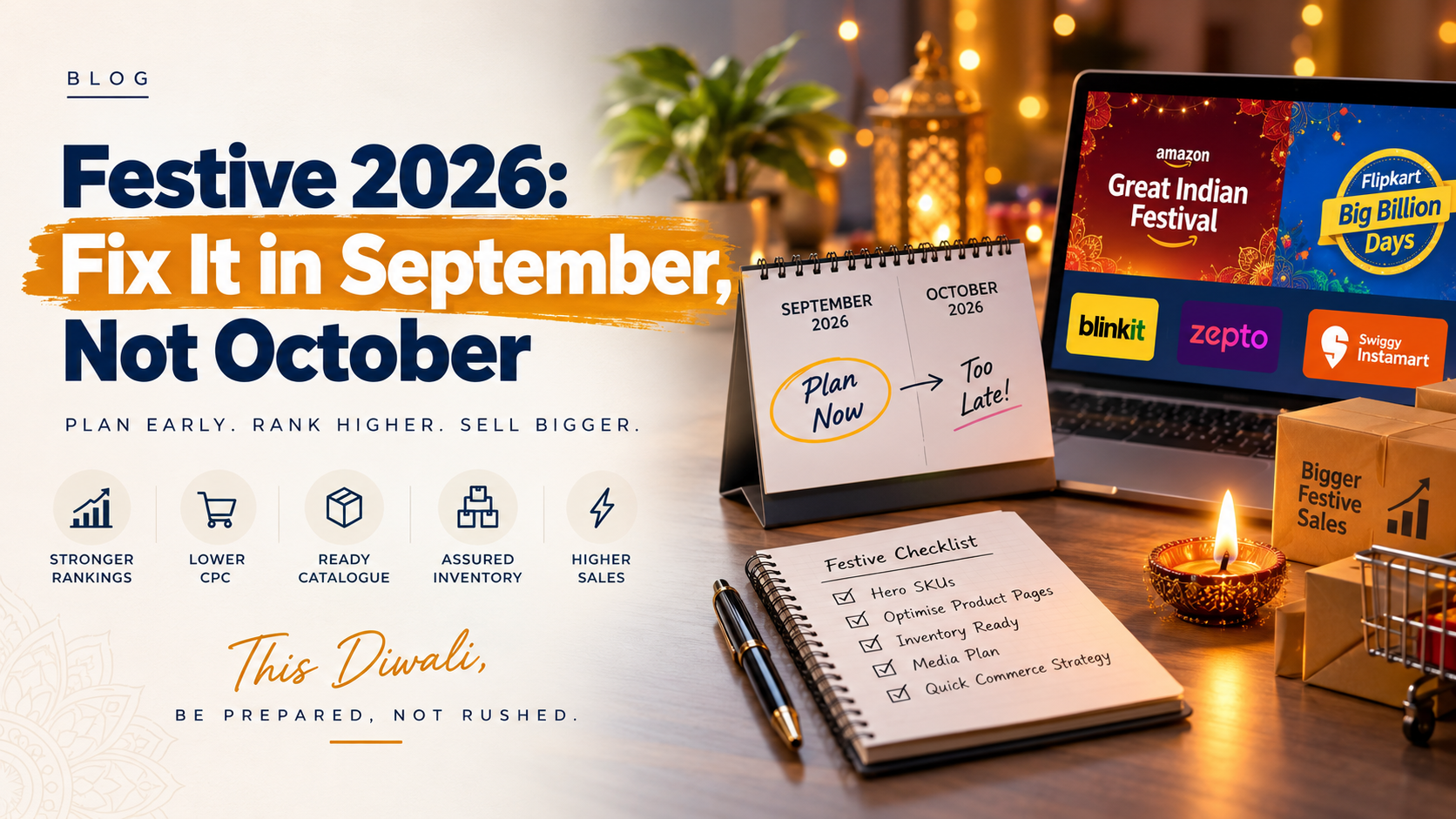
Festive 2026: Fix It in September, Not October
Diwali falls in early November this year, which sounds comfortably far away. It isn’t. Amazon’s Great Indian Festival typically opens in the third week of September, and Flipkart’s Big Billion Days lands in roughly the same window. That gives you weeks, not months. And the work that decides festive performance has to happen before the sale opens, not during it.
The scale involved is worth stating plainly. India’s 2025 festive season saw retail sales cross Rs 6 lakh crore, with shoppers spending heavily despite broader caution about household finances. For most consumer brands, a meaningful share of annual e-commerce revenue is decided inside a five to six week window. Yet festive retail media planning in most organisations begins in the first week of October, which is about a month too late to influence the things that matter most.
Here is what actually needs attention over the next three weeks.
Ranking needs a runway
Organic position on any commerce platform is a function of sales velocity, conversion rate and review depth accumulated over time. None of those can be bought in a week. A product that enters the festive window ranking fourth on its main search term will spend the entire sale paying to be seen, while the product ranking first collects the same traffic for free.
September is when you buy that position. Spend in the pre-festive lull is cheaper because fewer advertisers are competing, and every sale in that period compounds into ranking that pays off when traffic multiplies. Brands that hold budget back until the sale opens are choosing to buy the same visibility at peak prices.
Plan for the CPC curve, not the average
Cost per click does not rise smoothly through the festive period. It jumps when the sale opens, stays elevated through the peak days, and often spikes again in the final 48 hours before Diwali as brands rush to spend remaining budget. If your plan uses a single blended CPC assumption across the whole quarter, your October forecast is wrong in both directions. You will underspend during the cheap weeks and run out of budget during the expensive ones.
Build the plan in three phases instead. September is the build phase, where you buy ranking and clear catalogue debt at low cost. Late September through mid-October is the peak, where you defend position and accept a lower ROAS in exchange for volume. The final stretch before Diwali is a different game again, weighted toward gifting, larger baskets and last-minute purchase.
Freeze the catalogue before the traffic arrives
Every rupee of festive media flows through a product page. If that page is weak, the media only surfaces the weakness faster. Images, titles, bullet content, A-plus modules and variant relationships all need to be finished and live before the sale opens, because changes made mid-sale can temporarily disrupt indexing at the worst possible moment.
Review depth deserves specific attention. Shoppers comparing two similar products at a discount will use review count and rating as the tiebreaker, and a product sitting below the category average on either will convert worse no matter how good the placement. If a hero SKU is thin on reviews, September is the last month where anything can be done about it.
Match the media plan to the inventory plan
The most expensive festive mistake is not a bad bid. It is spending heavily against a SKU that goes out of stock on day four of the sale. Peak demand exposes every weakness in the availability footprint at once, and on quick commerce platforms it happens at dark store level, city by city.
Before the sale opens, agree with your supply chain team on which SKUs are genuinely protected for the full window and which are not. Weight media toward the protected ones. Set spend rules that reduce automatically when coverage falls. This conversation takes an hour in September and saves a great deal of argument in October.
Quick commerce plays a different festive game
Marketplaces and quick commerce peak differently. Amazon and Flipkart concentrate demand into announced sale events, driven by discounting and planned high-value purchases. Quick commerce peaks around the festivals themselves, driven by gifting, hosting, last-minute needs and impulse. Dhanteras and the two days before Diwali behave very differently on Blinkit than they do on a marketplace.
Budget accordingly. If you are running a single festive plan that treats all platforms as one channel with one calendar, you are almost certainly underspending on quick commerce during the days when it matters most, and overspending on it during the marketplace sale events when attention has moved elsewhere.

What to do this week
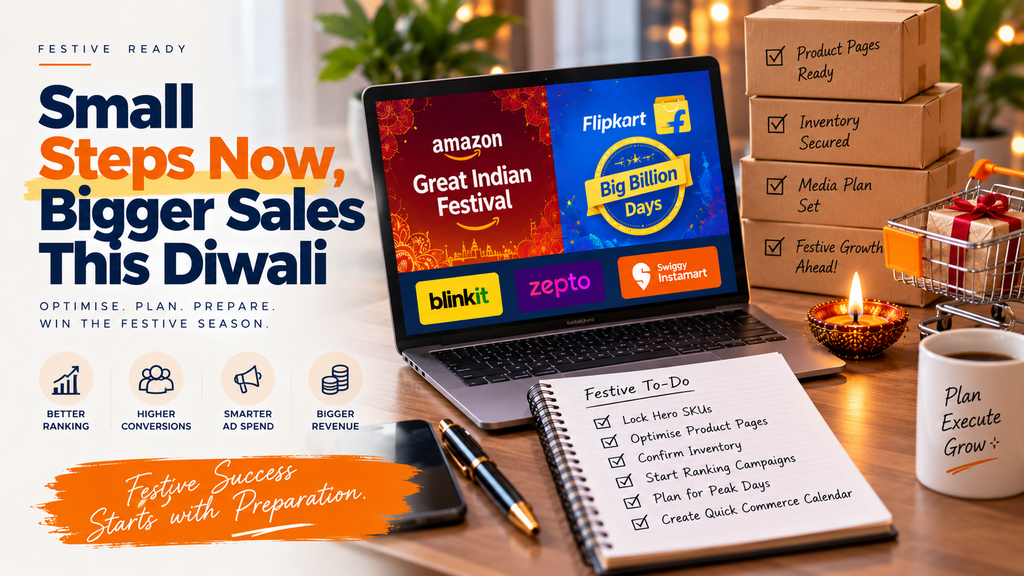
1. Lock your hero SKU list. Fifteen products you will genuinely support, not sixty you will spread thin.
2. Audit every hero SKU’s page today: images, title, A-plus content, variants, review count against category average.
3. Get written inventory commitments by SKU and region for the full window, and share them with whoever manages your bids.
4. Start the ranking build now. Spend in September on the terms you intend to own in October.
5. Split the budget into three phases with separate targets. Accept that peak-period ROAS will be lower, and decide in advance how much lower is acceptable.
6. Build a separate quick commerce calendar keyed to festival dates rather than platform sale dates.
Festive performance looks like it is decided in October. It is mostly decided now.
Minorista Digital plans and runs festive retail media for brands across Amazon, Flipkart, Blinkit, Zepto and Swiggy Instamart. If your festive plan is still a slide rather